How planning poker works
Three simple steps to better estimates.
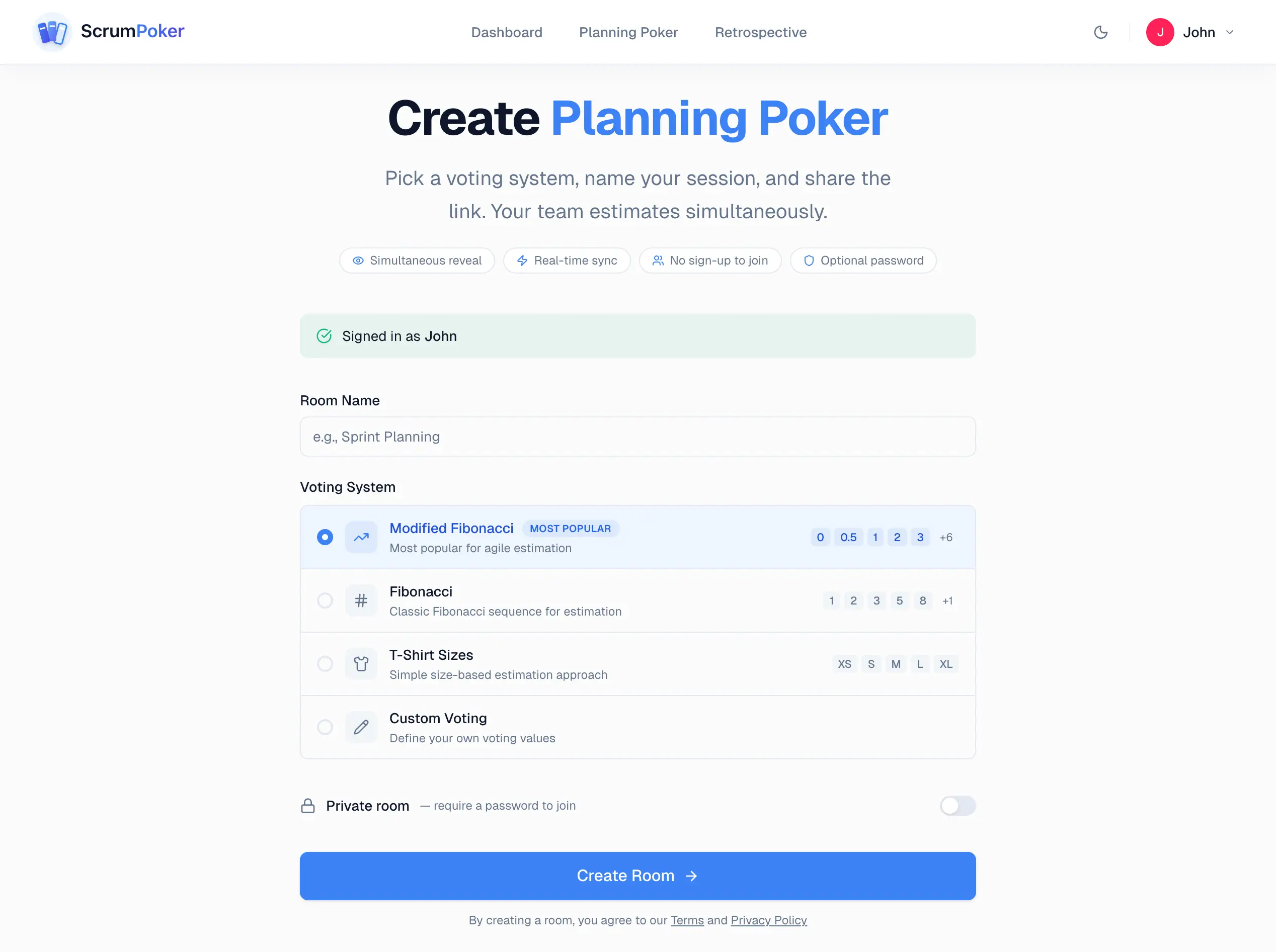
Create a room
Pick an estimation scale — Fibonacci, T-Shirt sizes, or your own custom deck — name your session, and share the room link.
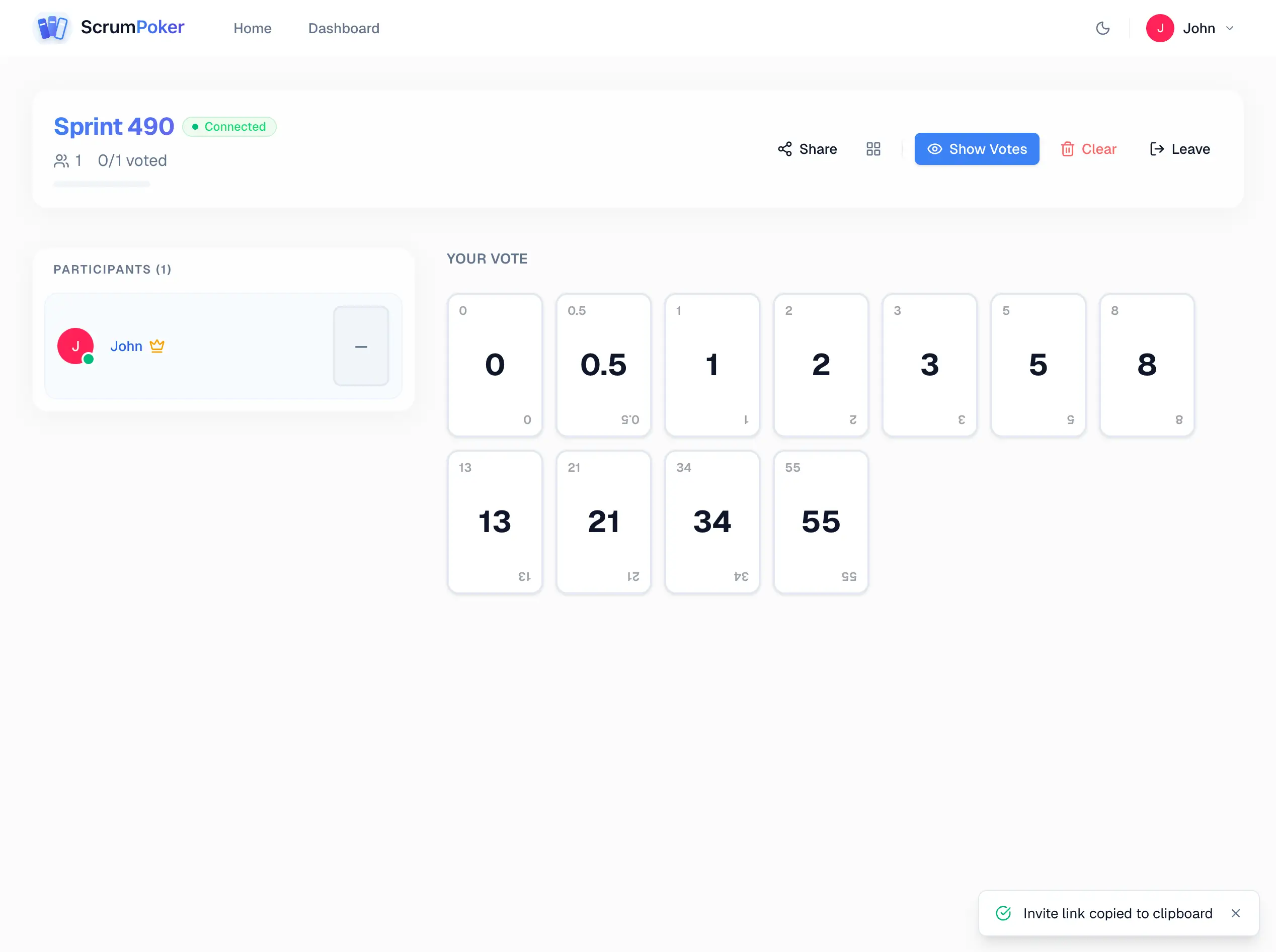
Pick your cards
Everyone joins the room and sees the full card deck. Select your estimate privately — cards stay face-down until the reveal.
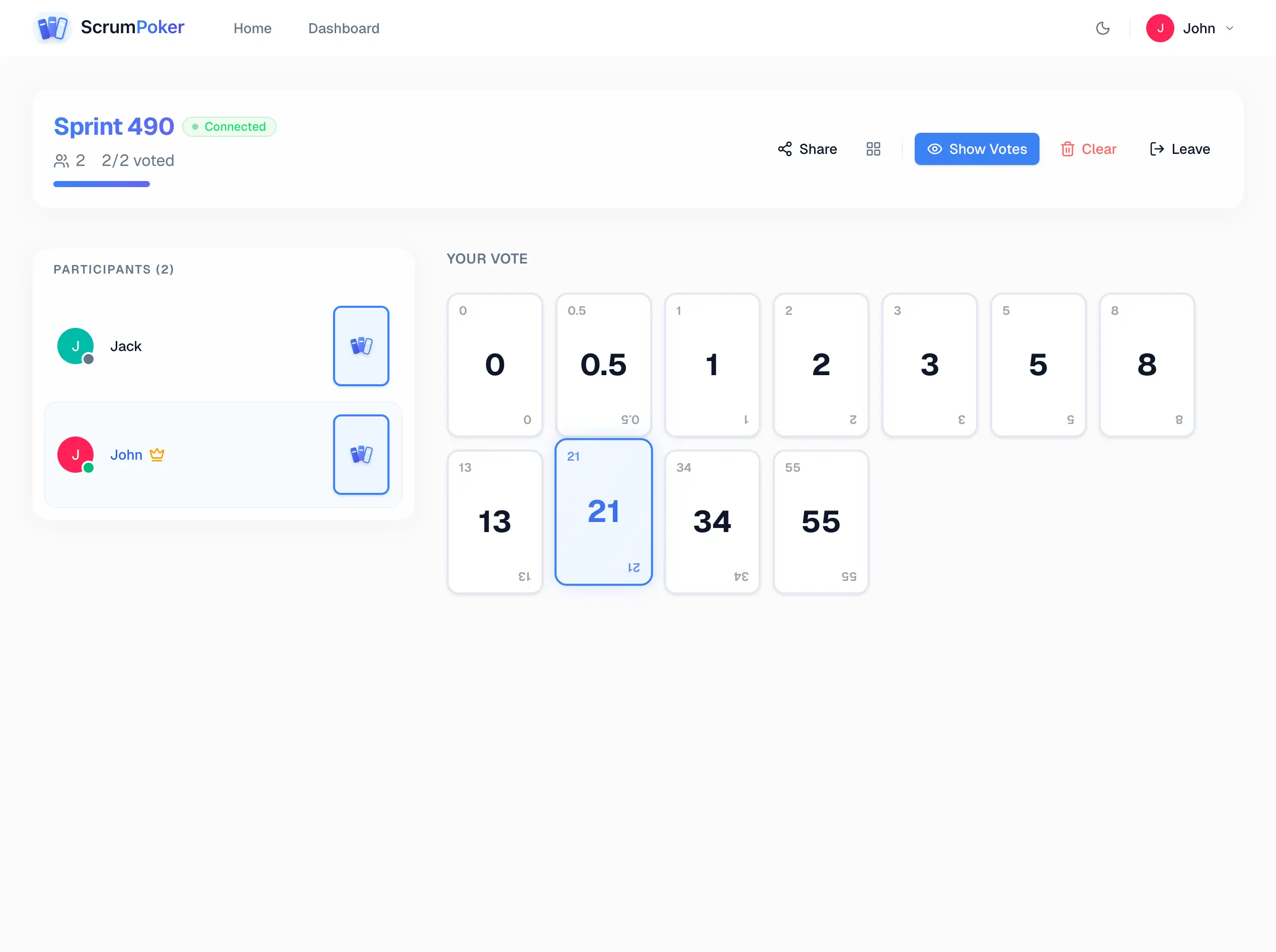
Vote simultaneously
All participants vote at the same time. You can see who has voted, but not what they picked — no peeking until everyone is ready.
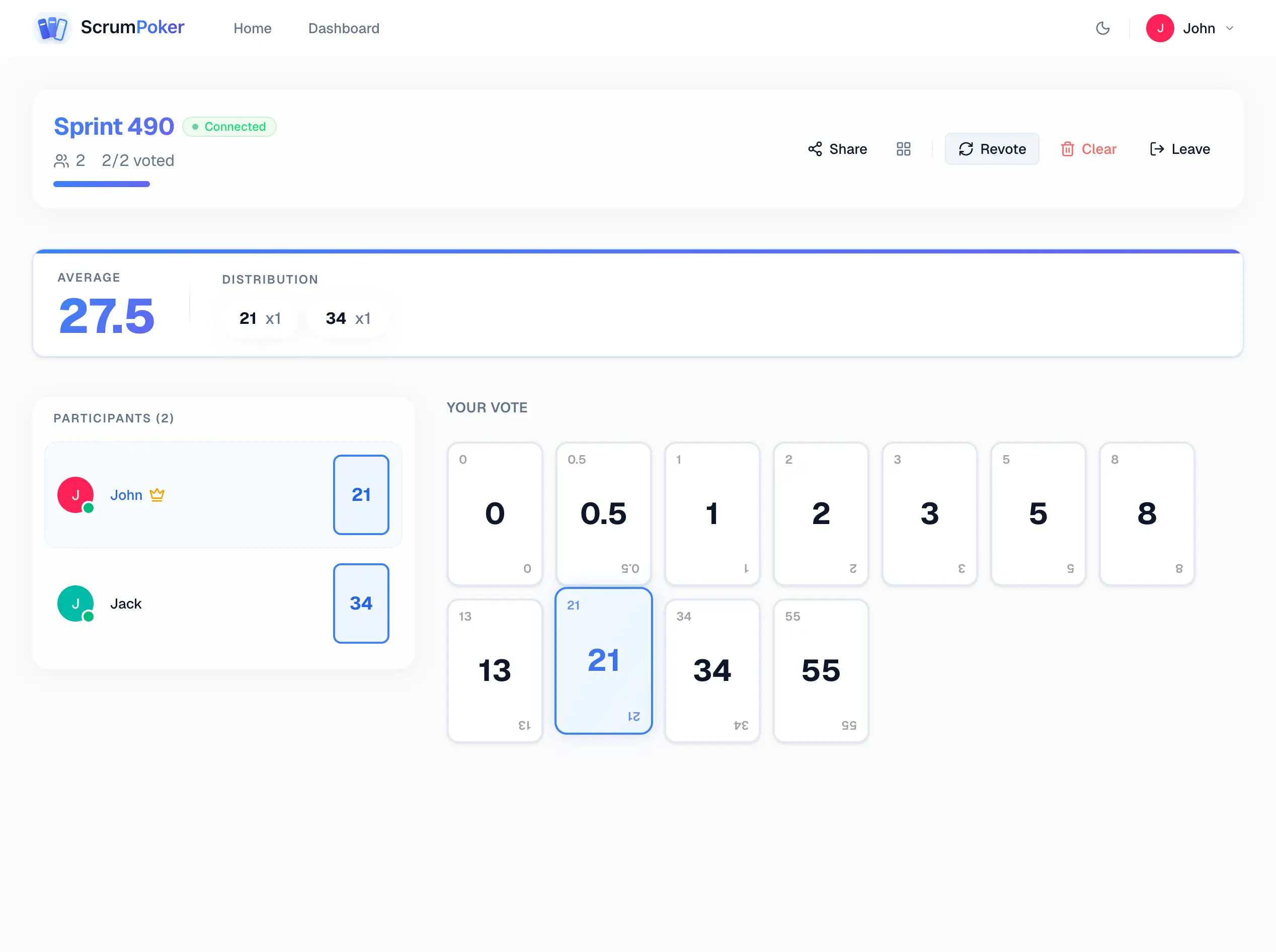
Reveal & discuss
All cards flip at once with the average and vote distribution. Discuss outliers and re-vote if needed until the team reaches consensus.
Choose your estimation scale
Pick from built-in scales or create a custom deck.
Fibonacci
0, 1, 2, 3, 5, 8, 13, 21
The most popular scale. Increasing gaps reflect growing uncertainty of larger items.
T-Shirt Sizes
XS, S, M, L, XL, XXL
Great for high-level estimation when numeric precision isn't needed.
Modified Fibonacci
0, ½, 1, 2, 3, 5, 8, 13, 20, 40, 100
A practical variation of Fibonacci, widely used in agile estimation.
Why teams use Scrum Poker
Better estimates, fewer surprises, happier sprints.
Team Consensus
Independent voting prevents anchoring bias and encourages diverse perspectives.
Reveals Unknowns
Estimate discrepancies surface misunderstandings and missing requirements early.
Iterative Rounds
Discuss outliers and re-vote until the team converges on an estimate.
Reduces Bias
Simultaneous reveal prevents senior members from influencing others.
Relative Sizing
Estimate complexity, not time — leading to more accurate sprint planning.
Better Planning
Accurate estimates lead to predictable sprints and reliable delivery.
Learn more about agile estimation
Deepen your understanding with our free guides.
What Is Planning Poker?
A complete guide to the estimation technique used by agile teams worldwide.
Read guideHow to Estimate User Stories
A practical guide to estimating user stories using story points.
Read guideStory Points vs Hours
Compare both approaches and learn when each estimation method works best.
Read guideScrum Estimation Techniques
An overview of planning poker, T-shirt sizing, dot voting, and more.
Read guideFrequently asked questions
Everything you need to know about Scrum Poker.
Planning poker (also called scrum poker) is a consensus-based estimation technique used by agile teams. Each participant privately selects a card representing their effort estimate, then all cards are revealed simultaneously. This prevents anchoring bias and encourages discussion about differing perspectives. Planning Poker is a registered trademark of Mountain Goat Software, LLC.
The Modified Fibonacci sequence (0, 1, 2, 3, 5, 8, 13, 21) is the most popular choice. The increasing gaps between numbers reflect the growing uncertainty of larger items. T-Shirt sizes (XS, S, M, L, XL) work well for high-level estimation where numeric precision isn't needed.
Most items reach consensus within 1-2 rounds of voting. If there's significant disagreement after the first reveal, the highest and lowest estimators explain their reasoning, and the team votes again. Rarely does it take more than 3 rounds.
Absolutely. Our tool is designed for remote and hybrid teams. All votes sync in real-time via WebSocket, so distributed team members can participate as if they were in the same room. Share the room link and everyone can join instantly.
Yes, it's completely free with no hidden costs. You can create unlimited rooms, invite unlimited participants, and use all features including custom voting scales. No credit card required, no trial period — free forever.
Scrum Poker is one of the best free planning poker tools available. It offers real-time voting, multiple estimation scales (Fibonacci, T-shirt sizes, Modified Fibonacci), simultaneous card reveals, and works seamlessly with remote teams — all completely free with no account required to join.
Create a free room on Scrum Poker, share the link with your team, and select a voting scale. The facilitator presents a user story, everyone votes by selecting a card privately, then all cards are revealed at once. If estimates differ significantly, the team discusses and re-votes until reaching consensus.
Popular planning poker alternatives include T-shirt sizing, dot voting, bucket estimation, and affinity mapping. However, planning poker remains the most widely used agile estimation technique because it combines individual thinking with group discussion, reducing bias and improving estimate accuracy.
No sign-up is required to join a planning poker session. Simply click the room link shared by your team and start voting immediately. Creating rooms is also free and takes just seconds — you can optionally create an account to manage your rooms from a dashboard.
Learn more about agile estimation
What is planning poker?
A complete guide to the estimation technique
What are story points?
How story points work in agile estimation
How to estimate user stories
Practical tips for accurate estimation
Fibonacci in agile estimation
Why agile teams use the Fibonacci sequence
Planning Poker is a registered trademark of Mountain Goat Software, LLC.